
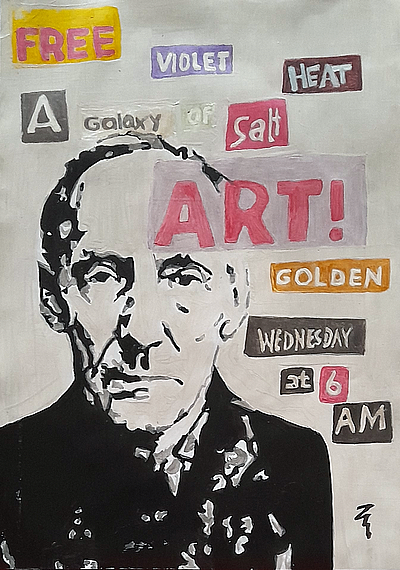
Burroughs’ claim that art is originally “magical and evocative” means that art began as a functional tool meant to alter reality—something closer to a spell or a formula than to aesthetic decoration. In this, he resembles Aleister Crowley, for whom Magick is “the Science and Art of causing change to occur in conformity with the Will.” Both see signs, images, and especially words not as passive objects of beauty but as operative instruments designed to do something.
Burroughs’ cut-up method directly extends this idea. By slicing and rearranging texts, he sought to break language out of its conditioned patterns and unlock its hidden power—a process that functions almost like a ritual, echoing Crowley’s notion that magical operations disrupt ordinary consciousness in order to open new realities. While “art for art’s sake” treats art as autonomous and purposeless, Burroughs and Crowley insist on art’s manipulative, transformative potential. In their view, art is not an aesthetic end in itself but a tool that reshapes reality and reorients consciousness.
Interestingly, the cut-up method rarely penetrated visual art in a comparable way. While collage exists, the systematic, reality-unlocking use of cut-ups that Burroughs envisioned found little equivalent in painting, which tends to rely on composition rather than disruption. Precisely for that reason, applying cut-up logic to painting becomes a compelling experiment: using fragmentation, rearrangement, or procedural “chance operations” to break the visual language in the same way Burroughs broke text. It would mean treating the canvas not as a unified composition but as a field where meaning is uncovered through rupture—an attempt to extend Burroughs’ magical, transformative technique into a domain where it has almost never been tried.